

Why Laser Hits and Action Scores Can Differ
A laser hit records where the pulse was detected. An action score rates how the firearm moved. Here is why one shot can do well on one and not the other.
A training app that uses both a camera and a motion sensor can give one shot two very different numbers. The hit can land in the center ring while the action score says the movement needs work. Or the action can look smooth while the hit lands low.
That is not necessarily an error. The two numbers come from different measurements and answer different questions. This article explains why they can disagree and what to check when they do. The examples are screens from the TEKAIM app preview showing simulated sample data.
Start with safety, not data
Neither number can confirm that a firearm is safe. NSSF defines a safe direction as one in which a bullet cannot possibly strike anyone, taking into account possible ricochets and the fact that bullets can penetrate walls and ceilings. Its rules say you should never point the gun at an unsafe target, even when dry firing with an unloaded gun. They also say to check the chamber, receiver and magazine for yourself. Keep all ammunition in another room, and when you finish, do not take another press after reloading, as Mantis’s dry practice rules advise. Our home safety checklist covers the rest. Follow the manuals for your firearm and training equipment, and local law.
Two numbers, two questions
| Number | Comes from | Answers |
|---|---|---|
| Ring or target score | A camera that detects the laser on the target | Where was the laser detected? |
| Action score | A motion sensor on the firearm | How did the firearm move around the shot? |
The tools on the market reflect that split. Mantis describes its Laser Academy app as capturing and displaying the point of impact, and says it does not do diagnostics. It describes MantisX as using a gyroscope and accelerometer to track movement during the trigger press.
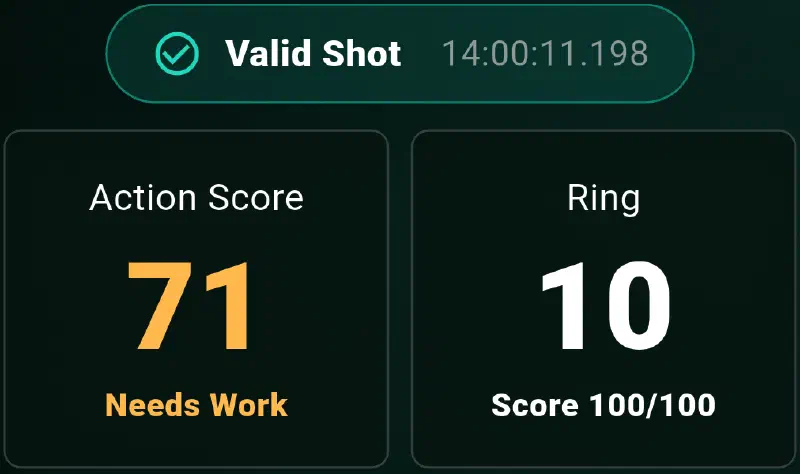
In the TEKAIM app preview, the main score on the result screen is the action score, which rates movement. The ring and target score come from where the laser was detected. They are shown side by side and kept separate, so a high ring does not raise the action score and a low action score does not lower the ring.
Why a good hit can come with a low action score
The hit is one moment. The action score covers a window. The TEKAIM device is designed to send a laser pulse when the trigger breaks. The camera records where that pulse lands. Movement after the pulse cannot move the hit, but the follow-through part of the action breakdown still looks at it. In the sample shot above, the follow-through part scored 15 and the trigger part 61. Follow-through, as Ed Head describes it, is resetting the trigger and looking at the front sight again, rather than jumping off the trigger to see the hit. A rushed recovery may cost points there without moving the hit at all.
Movement can cancel out. The muzzle can move and come back before the break. The hit can still land where it was aimed, even though the movement was there.
A ring is a range, not a point. A center ring covers an area. Two shots can both land inside it after very different amounts of movement.
Why a smooth action can still miss
The sensor does not know where you were aiming. A steady press with the sights on the wrong spot produces a steady movement trace and a poor hit. NRA Family describes trigger control as firing without disturbing aim, which assumes the aim was right to begin with.
The laser may not match the sights. If the laser is not adjusted to where the sights point, hits can land consistently off to one side even when the press is smooth. Check calibration before blaming the shot. Adjust the laser only after you have confirmed the firearm is unloaded and the ammunition is in another room, never look into the laser emitter to check it, and do not point the laser at anyone.
The camera setup affects the hit. Target lock, lighting, distance settings and camera position all affect where a hit is detected, and whether it is detected at all.
When one of the numbers is missing
Sometimes a shot has a hit and no movement data, or movement data and no hit. The laser may not have been detected, the sensor may have lost its connection, or the two records may not line up in time.
The TEKAIM app preview is designed to label each shot’s data quality: whether the motion data is valid, the laser is on target, the camera and sensor records match, and the device’s trigger event was received. A shot that fails one of those checks is incomplete. Treat it as missing data, not as a score of zero and not as a clean shot.
How to use both numbers together
| What you see | Possible causes to check |
|---|---|
| Good hit, low action score | Which movement part is low, and whether it happened before or after the break |
| Smooth action, poor hit | Aim, laser calibration, target lock and camera position |
| Both low | Start with setup and data quality, then movement |
| Both good | Confirm the pattern holds over a full session, not one shot |
Read these as possible causes, not conclusions. Compare sessions only when the target, distance and setup stay the same. Our guide to tracking dry fire progress covers how to keep them comparable, and Trigger Control Feedback explains the movement parts in more detail.
Where TEKAIM fits
TEKAIM is a training device being developed for dry-fire practice. It is designed to combine target-view feedback with motion data, and the app preview shows both on the same result screen.
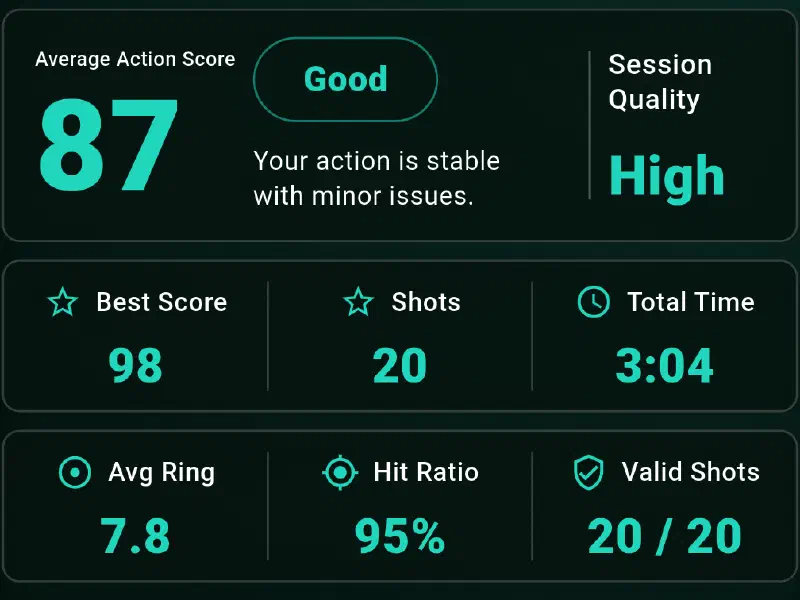
These screens come from a device simulator running sample data, not a real shooter. TEKAIM’s scoring rules, including how dry-fire practice is scored, are still being adjusted and validated, and so is real-device detection. Do not treat the scores in these previews as a benchmark. We do not publish accuracy figures yet. The action score is a movement rating. It is not a hit score, and it does not predict live-fire or match results.
This article is general educational information. It is not a substitute for hands-on instruction from a qualified instructor, local laws and range rules, or the manuals for your firearm and training equipment.